
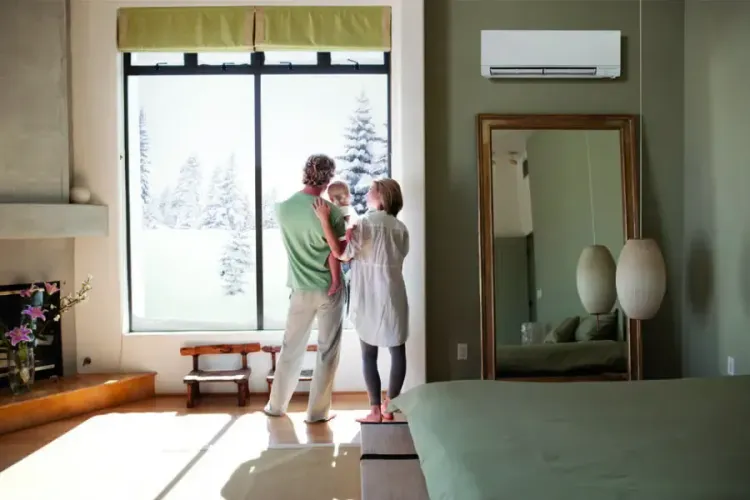
Shopping for a mini split comes down to two main concerns: getting a system that actually works well, and not spending more than you need to. Mitsubishi and MRCOOL DIY represent opposite ends of that spectrum, and the right choice depends entirely on what matters most in your specific situation.
Mitsubishi has spent decades perfecting mini split technology and delivers some of the most efficient, reliable systems you can buy. Their units handle extreme temperatures better than most competitors, run quieter, and last longer with fewer service calls.
MRCOOL DIY takes a completely different approach. Their systems use pre-charged line sets with Quick Connect fittings, allowing homeowners to handle installation without EPA certification or specialized tools. This cuts installation costs and puts the entire project under your control.
The choice isn't about which brand is "better" overall. It's about which system fits your budget, climate, installation preferences, and performance expectations.
Understanding the real differences between these brands helps you match the right system to your needs, rather than overspending on features you won't use or buying something that won't handle your climate properly.
Overview of Mitsubishi Mini Split
If you've researched mini splits for more than five minutes, you've seen Mitsubishi come up repeatedly as "the best" or "the gold standard." That is because Mitsubishi has been perfecting ductless HVAC since the 1950s, and it has built its brand on systems that simply work better, especially when conditions get tough.

Their systems stay quiet (we're talking library-quiet, even on high), maintain precise temperatures without the hot-and-cold swings that cheaper systems cause, and, most importantly, keep heating your home even when it's freezing outside. For instance, Mitsubishi's H2i systems operate down to -13°F and continue to operate down to -25°F. If you live anywhere with real winter, that's a massive deal.

However, all these features don't come cheap; you'll often pay a premium, 40-60% more than budget brands. Mitsubishi requires professional installation, which adds $ 3,000- $17,000 in labor costs, depending on your location and system size.
Where Mitsubishi Is Made
Mitsubishi manufactures its systems in Thailand, and it also has production hubs in Japan, Mexico, and China. Regardless of where they're assembled, the company maintains strict quality standards and stays in control of the entire production process.
Mitsubishi Range of Products
Mitsubishi doesn't make one system and call it a day. They offer multiple product lines because different situations need different solutions:
M-Series:

These top out at 33.1 SEER2, which translates to lower electric bills if you run your AC every time. They also include advanced air filtration that actually removes allergens (not just the basic dust filter most systems have) and better humidity control. If you live somewhere humid like Florida or the Southeast, these systems dehumidify without making your house feel like an icebox.
P-Series:
These hit up to 21.4 SEER2, and you get most of Mitsubishi's premium features at a lower price. This is what most Mitsubishi dealers actually recommend for standard residential applications because it balances cost and performance.
H2i Hyper-Heating:
If you live in Minnesota, Maine, or anywhere where winter actually means winter, the H2i hyper-heating is your best bet. These systems maintain full heating capacity down to -13°F and continue to operate down to -25°F. Their SEER ratings range from 17 to 30, depending on the model and configuration.
Customer Reviews with Mitsubishi
Talk to homeowners who've owned Mitsubishi systems for years, and the same points come up repeatedly: these things are quiet (you forget they're running), they maintain consistent temperatures without the fluctuations that drive you crazy, and they just keep working year after year.
Don't take our word for it. This HVAC contractor on Reddit loves Mitsubishi because of the brand's quietness and reliability:

However, one other user mentioned that the unit is noisy when in the heat mode:

… Some others feel the premium price isn't justified for their needs.

Pros
- SEER2 ratings up to 33.1 mean you're running the system for less money per hour. If you live somewhere hot and run the AC heavily from May through September, this efficiency difference can help you save hundreds of dollars every year.
- Mitsubishi's H2i systems maintain full heating capacity down to -13°F and continue to operate down to -25°F. If you live in a cold climate, this eliminates the need for expensive backup heating methods.
- Mitsubishi's premium models operate around 19-43 decibels indoors. Even the outdoor units run at 45-56 decibels, which won't bother neighbors or keep you awake.
- Mitsubishi's variable-speed compressors adjust in tiny increments instead of just blasting on and off. This keeps your room at your exact set temperature without the 3-5-degree swings typical of systems.
- Built to last 15-20+ years with basic maintenance.
Cons
- Premium pricing, expect to pay 40-60% more than budget brands:
- Professional installation required
- Limited availability of certified installers in some areas.
Overview of MRCOOL DIY
MRCOOL DIY changed the mini-split game by asking a simple question: Why should homeowners pay thousands for installation labor when the actual work isn't that complicated? They answered it by creating systems with pre-charged line sets that connect without specialized HVAC tools or refrigerant certification.

MrCool DIY Easy Pro, 5th Gen Ductless Mini Split
This means you can install an MRCOOL mini split system yourself in a weekend with the basic tools you probably already own. The line sets come pre-charged with refrigerant and connect using quick-connect fittings. So… you're literally just running the lines, mounting the units, and plugging everything in. This helps you save on installation costs.
Where MRCOOL is Made
MRCOOL manufactures its systems in China and is assembled in the United States. The design and engineering for the systems are also completed in the United States. Overall, they have a strict quality assurance process and oversee every stage of design, manufacturing, quality control, testing, and delivery to ensure high standards and reliable performance.
MRCOOL Offers and Range of Products
MRCOOL's product lineup focuses primarily on DIY-friendly systems for residential applications:
DIY Series:
These single-zone systems range in capacity from 9,000 to 36,000 BTU. They include everything needed for installation: indoor unit, outdoor condenser, pre-charged line set, mounting brackets, and hardware.

The pre-charged lines come in 16 or 25-foot lengths. If you need longer runs, you'll need professional installation with conventional line sets.
DIY Multi-Zone:
MRCOOL offers multi-zone DIY kits with dual, tri, and quad configurations. These use the same pre-charge line-set concept but let you condition multiple rooms from a single outdoor unit.
Universal Series:
The Universal Series is designed for homeowners who want a traditional, professionally installed HVAC solution. These ducted heat pump systems are compatible with existing ductwork and offer flexible installation options, a wider capacity range, and advanced inverter technology for efficient heating and cooling.
Advantage Series:

MrCool Advantage 9,000 BTU 5th Gen Ductless Mini Split
The Advantage Series provides a more traditional mini-split option that requires professional installation. These systems are ideal for homeowners seeking a cost-effective solution with reliable performance, quiet operation, and high energy efficiency, without the DIY-focused features such as pre-charged line sets.
📌Read more: MrCool Advantage vs DIY.
Customer Reviews with MRCOOL DIY
MrCool DIY is affordable and easy to install. One reviewer on Reddit explained that after getting quotes that were triple the cost, they chose a DIY MRCOOL system because of the affordable pricing with quality features:

Another Reddit user loves that it has low running costs. In their words: "I can't say enough good things about it…my electric bill has dramatically dropped." Check it out for yourself:

Another advantage is the warranty coverage. This user on Reddit had issues with their unit, and Mr Cool's warranty team responded quickly and shipped a replacement within a day:

SEER Ratings and Energy Efficiency
MRCOOL DIY systems achieve 17-22 SEER2 ratings depending on the specific model, which represents solid efficiency that meets federal standards and exceeds older systems significantly. To put that in context: if you're replacing a 10-year-old AC unit that was probably 13-14 SEER, you'll notice lower electric bills.

MrCool Advantage 12,000 BTU 5th Gen Ductless Mini Split
For instance, a 17 SEER2 MRCOOL system running in a hot climate costs roughly $400-500 annually in electricity for moderate use, and a 22 SEER2 unit costs $320-400. The differences might not look massive month to month, but over 10-15 years, higher-efficiency systems can save you $1,000-2,000+ in operating costs.
MRCOOL's inverter technology adjusts compressor speed rather than cycling on and off, improving efficiency and comfort compared to single-stage systems.
Compressor Technology and Performance
MRCOOL DIY systems use inverter-driven compressors, which means they can adjust their output based on your home's needs. This is a major improvement over older, single-stage systems that only turn fully on or fully off.
Instead of blasting cold or hot air, then shutting off and restarting later, the compressor ramps up and down gradually. This leads to steadier indoor temperatures, better efficiency, and a more comfortable feel throughout the day.
While MRCOOL doesn't offer the ultra-fine temperature control found in premium brands, its performance easily meets the comfort needs of most homeowners.
Overall, MRCOOL compressors deliver dependable, efficient performance in most U.S. homes, especially in moderate climates. You get modern comfort and energy savings without paying extra for extreme-cold-weather or precision features that many homeowners will never need.
Noise Levels and Comfort Performance
MRCOOL DIY systems operate at around 23-42 dB for indoor units and 53.5-63dB for outdoor units. This noise level is noticeable but rarely problematic for typical residential applications.
Warranty Coverage and Support
MRCOOL offers a standard 5-year parts warranty on their DIY systems, with a 7-year compressor warranty. If you register your system within 60 - 90 days of installation, you can extend the parts warranty to 7 years. This warranty coverage is solid for the price point.
Perfect for:
- Garages, workshops, bonus rooms: Adding climate control to spaces without existing HVAC, where running ductwork isn't practical or affordable
- Small homes or mobile homes: Where total cost matters more than maximum performance
- Rental properties: Where you want adequate climate control at minimum cost and aren't personally dealing with efficiency differences
- Moderate climates: Where winter rarely drops below 20°F and summer peaks below 105°F
- DIY-friendly homeowners: Who can competently drill through walls, run electrical lines, and mount heavy equipment safely
Not ideal for:
- Extreme climates: If you regularly experience 0°F winters with sustained sub-zero temperatures, these systems struggle to maintain heating capacity. You'll need backup heat for the coldest periods, which reduces the system's value proposition.
- Primary heating in cold climates: Below 20°F, heating capacity drops; you'll need backup heat
- Noise-sensitive situations: If whisper-quiet operation is your absolute top priority – perhaps for bedroom installations where every decibel matters – go for their premium models.
Pros
- The pre-charged line sets eliminate the need for specialized HVAC tools or refrigerant certification. If you're handy and comfortable working with basic tools, you can complete the installation in a weekend.
- Low upfront cost
- Works well in moderate climates for standard residential use
- All-in-one kits include everything needed.
- Solid efficiency (17-22 SEER2) beats older systems significantly
Cons
- Not engineered for extreme temperatures
- Louder than premium brands
📌Read more: MrCool mini split review.
Detailed Comparison Analysis Between Mitsubishi Mini Split and MrCool DIY
Energy Efficiency and Operating Costs
Mitsubishi Mini Split
Mitsubishi's premium M-Series tops out at 33.1 SEER2, with its mainstream P-Series achieving 22 SEER2. For a 12,000 BTU system running in a hot climate (750 hours annually at full capacity), expect to spend:
- 33 SEER2 system: ~$280-310 annually
- 22 SEER2 system: ~$340-370 annually
… assuming you spend $0.13/kWh on electricity.
Mitsubishi systems are engineered to maintain high efficiency across a much wider temperature range. When outdoor temperatures exceed 95°F, higher-efficiency systems continue to cool efficiently, while lower-cost systems consume more power to maintain the same comfort level. In winter, Mitsubishi's H2i models can provide reliable heat in very cold conditions without switching to expensive electric backup heat.
MRCOOL DIY
MRCOOL systems achieve 17-22 SEER2. For that same 12,000 BTU system:
- 22 SEER2 system: ~$340-370 annually
- 17 SEER2 system: ~$430-470 annually
The $60-100 annual difference between MRCOOL's high- and low-efficiency models matters over time. If you're buying MRCOOL anyway, spend the extra $200-300 for the higher SEER2 rating.

MrCool DIY Easy Pro 18,000 5th Gen Ductless Mini Split
MRCOOL's efficiency may drop more in extreme temperatures. When it's very hot or very cold, the system works harder and consumes more electricity than premium systems engineered for those conditions. However, this limitation affects only homeowners who regularly face extreme conditions. For typical residential use in moderate climates, MRCOOL's efficiency performs exactly as rated.
Verdict:
MRCOOL is the better choice for most homeowners. Mitsubishi's higher efficiency is worthwhile only if you use air conditioning heavily, live in a high-electricity-cost area, and plan to keep the system for 15 years or more.
Installation Requirements and Complexity
Mitsubishi Mini Split
Mitsubishi requires professional installation by an authorized dealer. There's no way around this if you want warranty coverage.
Professional installation ranges from $ 1,500 to $ 3,500+, depending on the number of zones, installation complexity, and system size. As expected, multi-zone systems will cost more.
MRCOOL DIY
MRCOOL is built specifically for homeowners who want to install the system themselves. The pre-charged line sets and quick-connect fittings mean you don't need HVAC-specific tools or to handle refrigerants.
A typical single-zone MRCOOL DIY install can be done in an afternoon if you're comfortable with basic home projects. You'll still need to drill a wall penetration, mount the equipment securely, and run electrical … but it's all very manageable if you take your time and follow the instructions.
📌Read more: MrCool mini split electrical requirements.
Long-Term Reliability and Maintenance
Mitsubishi Mini Split
Mitsubishi systems last 15-20 years with basic maintenance, and it's not uncommon to see units still functioning after 25 years. The company engineers their components for longevity, using higher-grade materials and more conservative operating parameters.
MRCOOL DIY
MRCOOL systems last 10-15 years with proper maintenance. The lower-cost components and less conservative engineering mean they don't quite match premium brands' longevity, but they're not disposable either.
Verdict:
Mitsubishi has the edge in long-term durability, since their systems commonly last 15–20+ years and require minimal maintenance. MRCOOL systems have a shorter lifespan of 10–15 years, but still offer solid reliability when properly maintained.
Performance
Mitsubishi Mini Split
Mitsubishi really shines when it comes to temperature control. Its variable-speed compressors can adjust in very small steps (literally hundreds of speed levels) so the system makes gentle, constant adjustments to stay right at your set temperature. In real-world use, that usually means temperature swings of less than a degree.
This makes a bigger difference than it sounds. Lower-end systems tend to run at full power, overshoot the target temperature, shut off, and then wait until the room cools by 3–5 degrees before kicking back on. The result is a constant cycle of being a little too warm, then a little too cool. Mitsubishi systems avoid this altogether by quietly maintaining the exact temperature you set.
MRCOOL DIY
MRCOOL systems provide solid, reliable performance that satisfies residential comfort needs. The variable-speed compressor adjusts to load, maintaining relatively stable temperatures with 1-2 degree swings. You're getting much better performance than old single-stage systems or window units.

MrCool DIY 24,000 BTU 5th Gen Ductless Mini Split
Cooling performance is effective and dependable up to about 100-105°F outdoor temperature. Above that, the system works harder and less efficiently, but it still cools effectively. In typical summer conditions (85-95°F), MRCOOL systems handle cooling demands well.
Verdict:
MRCOOL provides strong, reliable performance for typical residential use. Temperature stability, cooling effectiveness, and overall comfort are more than adequate for most homes and climates.
Mitsubishi, however, delivers superior performance, especially in temperature precision and extreme cold-weather heating. Its ability to maintain near-perfect setpoints and full heating capacity in sub-zero conditions makes it the better choice for homeowners who demand maximum comfort and live in harsh climates.
How to Choose the Right Mini Split for Your Needs
1. Decide Between DIY and Professional Installation
Start by assessing your DIY capability and comfort level. For instance, MRCOOL's pre-charged systems simplify installation, but you're still:
- Drilling through exterior walls (requires hitting the right spot, creating a proper drainage slope)
- Mounting 40-70 pound equipment securely at heights
- Running electrical lines (potentially 220V circuits)
- Following precise instructions for quick-connect fittings
If you've successfully tackled projects like installing a ceiling fan, running electrical for outdoor lighting, or mounting heavy equipment, you can handle this.
2. Consider Your Home's Size, Insulation, and Layout
Mini split sizing matters. Too small, and the system runs constantly without maintaining temperature. Too large and it short-cycles, wastes energy and provides poor humidity control.

For a single-zone system, you need to match BTU capacity to the space you're conditioning:
- 9,000 BTU: Up to 300-400 sq ft (small bedroom, office)
- 12,000 BTU: 400-550 sq ft (large bedroom, small living area)
- 18,000 BTU: 550-800 sq ft (large living room, small apartment)
- 24,000 BTU: 800-1,100 sq ft (open floor plan, multiple rooms)
These numbers assume average insulation, 8-foot ceilings, and moderate sun exposure. You can adjust down if you have exceptional insulation or up if you have poor insulation, lots of windows, high ceilings, or extreme sun exposure.
Layout matters too. Mini splits perform best in open spaces or when positioned to condition adjacent rooms through doorways. If rooms are isolated or on opposite ends of the house, you'll need multiple indoor units. A single head can't effectively cool spaces; it can't "see."
3. Consider Your Budget
Be realistic about the total project cost, not just equipment price. MRCOOL systems often save $3,000–$5,000 compared to professionally installed premium brands. For many homeowners, that upfront savings easily outweighs the benefits of slightly higher efficiency or a longer lifespan.
If keeping initial costs low while still getting dependable comfort is your main goal, MRCOOL is the better financial choice. If you're willing to pay more upfront for top-tier efficiency, longer system life, and ongoing dealer support, you can opt for Mitsubishi.
4. Evaluate Energy Efficiency and Climate Needs:
Your climate directly determines which features matter most when choosing between these systems.
In hot, sunny regions, such as the Southwest or much of the Southern U.S., MRCOOL's 17 – 22 SEER2 is more than enough. It saves a lot of energy compared to older systems without the higher price of premium brands.
But if you live somewhere that often gets below 20°F for long stretches, a Mitsubishi mini split is the better choice. Mitsubishi systems are designed to maintain efficient heating in very cold weather, while lower-cost systems can struggle or require expensive backup heat.
5. Evaluate Brand Reputation and Service Support
Before committing to any brand, take time to verify local support availability, as this directly affects your long-term ownership experience.
For MRCOOL, research customer service reviews that specifically mention warranty claims to get a realistic picture of support quality. And when purchasing MRCOOL systems, consider buying from authorized retailers like us at Commercial Cleaning Depot.
We offer competitive pricing, reliable shipping, and knowledgeable support for DIY installations to help you succeed with your project.
For Mitsubishi, work exclusively with their authorized dealer network for both installation and service. Remember that you're locked into this dealer network, which limits competition and your negotiating power on both installation and service costs.
Mitsubishi vs MRCOOL DIY — Which Should You Go For?
Choose MRCOOL DIY If…
- You want a DIY-friendly system with a lower upfront cost
- You're handy and want control over installation
- You need climate control for a garage, a bonus room, or a small area
- You live in a moderate climate
- You're outfitting a rental property
Choose Mitsubishi If…
- You live in an extreme climate.
- You're replacing your primary HVAC system
- You prioritize quiet operation
- You want maximum efficiency and lowest operating costs
- You prefer professional installation
Conclusion
The choice between Mitsubishi and MRCOOL DIY ultimately comes down to your specific circumstances, budget, and comfort priorities.
Mitsubishi builds systems that excel in extreme climates and deliver whisper-quiet operation, but these premium features come with premium pricing that puts them out of reach for many homeowners.
Ready to make mini split technology a reality in your home? Browse our selection of MRCOOL DIY systems, or contact our team for personalized guidance on selecting the right system for your specific application.