
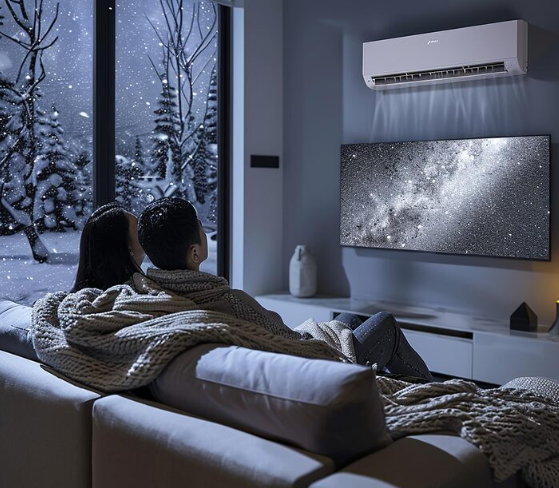
Yes, a MrCool DIY mini split can handle cold weather. The 12k, 18k, and 24k BTU 4th Gen models are rated to keep heating down to -13°F. This covers most of the continental United States, including states like Minnesota, Michigan, and upstate New York, where winters get brutal.
The real question isn't whether it works in the cold, but how well it performs in your specific conditions and whether it can fully meet your heating needs on its own. This guide breaks that down, covering real-world performance, limitations, and how to choose the right size and setup so you can decide confidently before buying.
How a MrCool Mini Split Heat Pump Works in Cold Weather

MrCool DIY Hyper Heat 18,000 BTU 5th Gen Ductless Mini Split
Most people assume a heat pump works like a space heater — plug it in, and it makes heat. But that's not how it works. A heat pump draws warmth from the outside air and transfers it into your home.
Here's how:
The outdoor unit contains a refrigerant – a special fluid that gets so cold it can absorb heat from the air. It soaks up the heat, carries it inside, and releases it into your room through the wall unit. In simple terms, a heat pump pulls heat out of the cold outside air and pushes it into your home.

What makes the MrCool DIY work well in cold weather is its inverter compressor. Instead of running at one fixed speed, the inverter continuously adjusts output based on heating demand. On very cold nights, it ramps up and runs harder to maintain indoor temperatures. On milder days, it slows down and runs at a lower capacity. This constant modulation leads to more stable indoor temperatures, improved energy efficiency, and lower operating costs.
Your House Matters as Much as the System
Two houses on the same street can have completely different heating needs. A newer, well-insulated home with high-quality windows can retain heat like a thermos. An older home with drafty windows, thin insulation, and air leaks loses heat much more quickly.
Because of that, the same mini-split system that comfortably heats one home may struggle to keep up in another, even if both houses are the same size.

MrCool DIY Hyper Heat Ductless Mini Split
This is where the balance point becomes important. For context, the balance point is the outdoor temperature at which your heating system can no longer keep pace with the rate at which your home loses heat.
- Above the balance point, the system can handle heating the home on its own
- Below the balance point, the home loses heat faster than the system can replace it, so backup heating is needed
Also, the balance point is not fixed. It varies based on factors such as insulation quality, air leakage, window size, ceiling height, and overall square footage. A system sized correctly for a tightly sealed, well-insulated home in Minneapolis could easily be undersized for a draftier home just a few blocks away.
This is why heating design can't rely on simple BTU-per-square-foot rules, especially in cold climates. Real performance depends as much on the building itself as it does on the equipment inside it.
MrCool DIY 4th Gen vs. Hyper Heat vs. 5th Gen — Which One Is Right for Cold Climates?
Mr. Cool sells three versions of the DIY mini-split, and each performs differently in cold weather. Here are the main differences between them

MrCool DIY HyperHeat 12,000 Mini Split Heat Pump Condenser
Standard 4th Gen — Good for Most, Not for the Harshest Climates
The standard 4th Gen is a well-built, efficient system that homeowners can use as their main heat source, as long as they size it correctly and keep some backup heat on hand. It's the most affordable option in MrCool's lineup, and you can install it yourself in a weekend.
However, in cold climates, it loses about half its heating power by 5°F. Also, it doesn't qualify for cold-climate certifications or the rebates that come with them.
Is the 4th Gen Actually a Cold-Climate Heat Pump?
ENERGY STAR has a specific definition for what qualifies as a cold-climate heat pump. To earn that certification, a system must retain at least 70% of its heating capacity at 5°F, compared to its output at a mild outdoor temperature of 47°F. In simple terms, if a system produces 100 units of heat in mild weather, it should still deliver at least 70 units when temperatures drop to 5°F.
The MrCool 4th Gen 18k retains about 54% of its heating output at 5°F and delivers roughly 11,790 BTU at 5°F, compared to 21,640 BTU at 47°F. This falls short of the 70% threshold required for cold-climate certification, and the 12k and 24k single-zone models perform in a similar range.
Most standard 4th Gen single-zone models do not qualify for ENERGY STAR cold-climate certification based on these numbers, but eligibility can vary by model, and MrCool does update its lineup. To verify whether your exact model qualifies, check the ENERGY STAR Certified Heat Pumps database directly.
This doesn't make the 4th Gen a bad heater. It works well in moderately cold climates, and its efficiency numbers are genuinely good. But most standard 4th Gen models are not cold-climate certified by the official definition. They won't qualify for cold-climate rebate programs, and in the harshest winter conditions, it may require backup heating to reliably maintain comfort.
5th Gen Hyper Heat — Best for Cold Climate
The DIY Hyper Heat is the best for harsh winters. It works down to −22°F and holds onto at least 70% of its heating power at 5°F, which meets the ENERGY STAR cold-climate standard. Where the regular 4th Gen 18k is down to about half its heating power in deep cold, the Hyper Heat is still going strong. It carries a SEER2 of 23.5 and an HSPF2 of 10.0 (the 12K model), and it qualifies for cold-climate rebate programs in states like Maine and Massachusetts.
If you're in a state like Michigan, Wisconsin, Massachusetts, or southern Minnesota and want to avoid needing a backup heater altogether, or in northern Minnesota, Maine, Montana, or the Dakotas and want to use one as rarely as possible, the Hyper Heat is the right version to buy.
5th Gen Standard — Cleaner and Newer, Same Cold-Weather Ceiling
The 5th Gen uses a newer refrigerant called R-454B, which is much better for the environment than the R-410A in the 4th Gen — roughly 4.5X lower impact. As the EPA phases out R-410A, systems running R-454B will have better long-term access to parts and service, which matters for a system you plan to run for 15 years.

MrCool Advantage 5th Gen Mini Split Heat Pump System
In cold weather, the standard 5th Gen non-Hyper Heat models hit the same −13°F floor as the 4th Gen. Efficiency is also better, but the cold-weather performance is the same as the 4th Gen.
Note: If you already own a 4th Gen, you can't mix the two generations on the same system. They use different refrigerants and different line sets, so they need to stay completely separate.
Side-by-Side Comparison
|
Feature |
4th Gen Standard |
DIY Hyper Heat |
5th Gen Standard |
|
Refrigerant |
R-410A |
R-454B |
R-454B |
|
Lowest heating temperature |
-13°F |
-22°F |
Varies by model (-13°F typical) |
|
ENERGY STAR Cold Climate |
No |
Yes |
Some models |
|
Maintains 70%+ output at 5°F |
No |
Yes |
Varies by model |
|
Compatible with existing 4th Gen line sets |
Needs verification |
Needs verification |
Needs verification |
|
Best use case |
Mild-to-cold climates |
Severe winter climates |
Mild-to-cold climates |
*Eligibility varies by specific model number. Verify your exact unit at the ENERGY STAR Certified Heat Pumps database before applying for rebates.
Is a MrCool DIY Mini Split Enough to Heat Your Home Through Winter?
The MrCool DIY lineup covers a wide range of cold-weather needs — from the standard 4th Gen, which handles moderate cold climates well, to the Hyper Heat, which is built for harsh winters. Whether any of them is enough as your sole heat source depends on which model you buy, where you live, and how well your home holds heat.
A MrCool DIY mini split makes good sense as your main heat source when:
- You live in most of the continental U.S., with the standard DIY setup, where winters stay above −5°F for most of the season. This covers states like Ohio, Indiana, Illinois, Pennsylvania, Michigan, Wisconsin, Iowa, Nebraska, New York, and all of New England.
- You live in the coldest northern states with the Hyper Heat, which is rated to −22°F and holds onto at least 70% of its heating power at 5°F. In places like northern Minnesota, northern Maine, or Montana, the Hyper Heat can serve as a primary heat source in a well-insulated home in a way the standard model cannot.
- Your home is reasonably well-insulated, with decent windows and not many drafts. Better insulation means your home holds heat longer, so the system doesn't have to work as hard on cold nights, regardless of which model you choose.
- You're heating a specific area — a bedroom addition, a finished garage, a sunroom, or a basement. Mini-splits are great for this because they heat only the space you want without running your whole-house system.
- You're replacing electric baseboard heaters or window units. Homeowners making this switch in states like Ohio, Michigan, Illinois, and Massachusetts see about 30%-50% lower heating bills.
- You want to skip a large installation bill. Professional mini-split installation costs $2,000 to $5,000 for a single-zone system, and higher for multi-zone systems. With MrCool's pre-charged Quick Connect line sets, you can install any model in the DIY lineup without special tools or an HVAC license.
Where You Shouldn't Rely on It Alone
- Northern states with the harshest winters, using the standard DIY, like northern Maine, northern Minnesota, North Dakota, Montana, and Wyoming. The standard model doesn't have enough cold-weather output for these conditions without backup. This is exactly what the Hyper Heat is for.
- Poorly insulated older homes. If your house leaks heat through thin walls and drafty windows, the problem is the building, not the mini split. Sealing and insulating first will do more for your comfort and bills than buying a bigger system.
- Homes without a power backup plan, especially in places where winter storms knock out power. Heat pumps run on electricity. When the grid goes down in a blizzard, no backup means no heat, and this applies to the Hyper Heat just as much as the standard model.
- Uninsulated garages in serious winters. An uninsulated garage loses heat so quickly that even a correctly sized mini-split can end up running flat out, never reaching your target temperature, and costing a small fortune. Insulate the space before you buy the system.
How to Size a MrCool DIY Mini Split for a Cold Winter
Most people start with the "1 ton per 500 square feet" rule, find the BTU number that matches their room size, and buy that model. The problem is that the rule comes from summer cooling calculations. It has nothing to do with how much heat your home needs on a 5°F January night.
The BTU number on the box is measured at 47°F outside. By the time it hits 5°F, you have roughly half that output, as the table above shows. If you thought you were buying 18,000 BTU of heating, you actually have about 11,790 BTU when it matters most.
The Right Way to Calculate Your Heating Needs
The best method is called a Manual J calculation. Instead of guessing based on square footage, you figure out how fast your specific home loses heat. It takes into account your insulation, windows, ceiling height, and local weather … all the things that affect how hard your heating system actually has to work.
Practical Sizing Adjustments for Cold Climates
Once you have a heating number, apply these adjustments:
- Add 10-20% to your number if you're in Zone 5 or colder. This extra cushion covers the coldest nights without pushing the system to its limit.
- Account for high ceilings. More ceiling height means more air to heat. Add roughly 10-20% for each additional foot above 8 feet.
- Size to a typical cold day, not the worst day of the year. Target the temperatures you'll see most often — around 10 to 17°F — and let backup heat handle the rare nights below that.
Is It Worse to Buy Too Big or Too Small?
In cold climates, being too small is the more dangerous mistake. An undersized system will run at full speed around the clock, never quite reach your target temperature on cold nights, wear out faster, and push your electricity bill sharply higher. The homeowners who report tripled heating bills in winter almost always have a system that's too small for the space it's trying to heat.
Going slightly too big is less of a problem with the MrCool DIY. The inverter compressor runs more slowly on mild days rather than cycling on and off repeatedly. It costs a bit more upfront and may not manage humidity as well during fall and spring, but it won't leave you cold in January. When in doubt, size up.
Heating Multiple Rooms with a Multi-Zone Setup
To heat more than one room, the MrCool DIY multi-zone system connects multiple wall units to a single outdoor unit. Size each room's wall unit to that room's individual heating need using the cold-weather output numbers, not the nameplate. The outdoor unit can handle about 30% more than the combined capacity of all the indoor units, because all rooms rarely need maximum heat at the same time. That's completely normal and how these systems are meant to work.
Pros of Using MrCool DIY Mini Splits in Cold Climates
These apply to all models in the MrCool DIY lineup:
- Pre-charged Quick Connect line sets require no special tools and no HVAC license.
- One system for heating and cooling. It heats in winter and cools in summer from the same unit, with no separate air conditioner needed.
- Real savings on monthly bills.
- Built for tough conditions. Gold Fin coating on the outdoor coil resists rust and salt air.
- Wi-Fi control built in, with Alexa and Google Home compatibility.
- 7-year compressor coverage and 5-year parts warranty when you register the unit after installation.
If you want to buy the standard 4th Gen specifically:
- Most affordable entry point in the DIY lineup.
- Efficient for moderate cold climates.
If you want to buy the Hyper Heat:
- The strongest cold-weather performance in the DIY lineup.
- ENERGY STAR cold-climate certified, meaning it retains at least 70% of its heating power at 5°F. The standard 4th Gen retains roughly 54%.
- Qualifies for cold-climate rebate programs
Cons
- No built-in backup heat. Many competing brands include electric heat strips in the wall unit that kick on automatically in extreme cold. Mr. Cool DIY models don’t. Any backup is a completely separate device.
The standard 4th Gen:
- Most standard models are not cold-climate certified.
- The 36k single-zone stops at 5°F, making it the worst cold-weather option in the lineup despite being the largest model.
- Backup heat is required in the coldest northern states, such as northern Minnesota, the Dakotas, Montana, and Alaska.
- R-410A is being phased out. Getting it serviced will become harder and more expensive over time.
The Hyper Heat:
-
Higher upfront cost than the standard 4th Gen.
Final Verdict — Should You Buy a MrCool DIY Mini Split for Cold Weather?
Yes, but the right answer depends on where you live and which model you're buying.
If you're in a state like Ohio, Michigan, Illinois, Wisconsin, Massachusetts, or New York, the standard 4th Gen is a solid choice. It handles real winters well, costs less to install than a professionally installed system, and will cut your heating bills compared to electric baseboard or window units.
If you're in northern Minnesota, the Dakotas, Montana, northern Maine, or anywhere that regularly sees temperatures below −10°F, the Hyper Heat is the best option. It's rated to −22°F and holds onto at least 70% of its heating power at 5°F.
We carry the full MrCool DIY lineup, including the 12k and 18k models, which are best suited for cold-climate use. Or speak with any of our HVAC experts for the right pick.
Frequently Asked Questions
Can a MrCool Mini Split Heat a Whole House in Winter?
Yes, a single-zone unit effectively heats a single room or area. To heat a whole house, you'd use a multi-zone MrCool DIY system that connects multiple wall units to a single outdoor unit. Each room has its own wall unit and temperature setting, with no ductwork involved.
Why is my Mr. Cool Air in Heating Mode?
It's almost certainly in defrost mode. When frost builds up on the outdoor coil, the system briefly reverses to melt it. During that 5- to 15-minute window, the wall unit pushes out cool or room-temperature air, and you may see steam coming from the outdoor unit.
Does It Qualify for Rebates or Tax Credits?
The standard 4th Gen models don't qualify for rebates that require ENERGY STAR cold-climate certification as they don't meet the cold-weather performance threshold. The DIY Hyper Heat may qualify for Efficiency Maine rebates (requires installation by a registered Efficiency Maine vendor) and Mass Save rebates in Massachusetts. Verify current eligibility at the state program's website before purchasing.