
A commercial vacuum is made for a cleaning crew to use through full shifts, and a residential vacuum is made for household use. You can see the key differences in the warranty, the motor, the cord, the capacity and the filtration. On a commercial upright like the Sandia Force 14, your crew gets a 50-foot cord and bags they can order by the 10-pack.
Commercial Vacuum Cleaner vs Residential: Five Key Differences
Warranty
Plenty of small offices start out with a vacuum someone brought from home, and nobody reads its warranty until the motor quits. Household vacuum warranties usually cover home use only, and some name janitorial work as an exclusion, so a home machine on a nightly route can end up with no coverage at all. Commercial makers write their warranties for that route. The EDIC 600TV Atlas comes with five years on parts and labor and a lifetime warranty on its housing.
Motor and Hours of Use
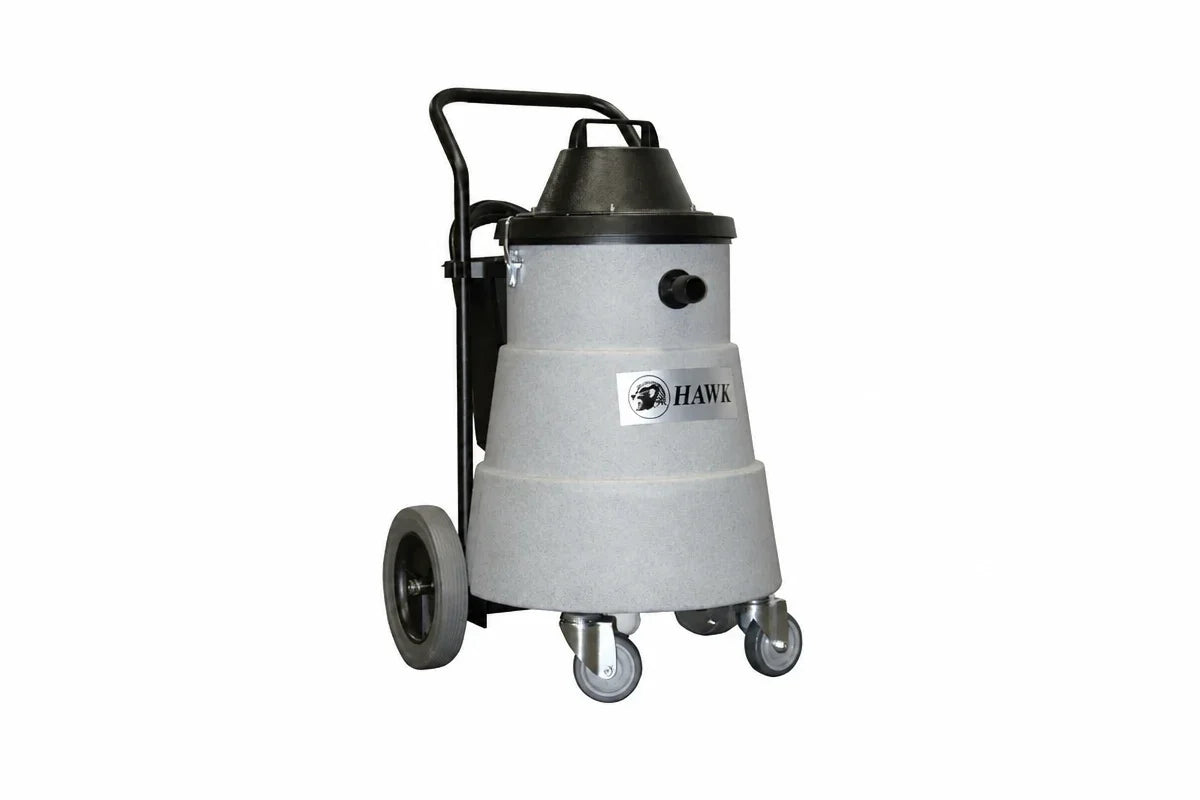
At home, a vacuum comes out for half an hour on the weekend. On a cleaning route, your crew might keep the same machine going from six in the evening until the last office is done. The Sandia Force 14 has two motors, one for suction and one for the brush, and the brush motor shuts off on its own when your crew stands the handle upright. On the HAWK V20, an automatic shut-off trips before water can reach the bypass motor (the air goes around the motor, not through it).

Cord and Reach
Every time your crew pulls a plug and goes looking for the next outlet, they're on the clock and nobody is vacuuming. The Force 14 and the Sandia Super Raven both come with 50-foot cords, so your crew can work down a row of offices from one outlet. The HAWK V20 has a 35-foot cord in two parts, and if a cart wheel crushes one part, your crew can replace that section and keep the other.

Capacity and Bags
The 20-gallon tank on the HAWK V20 holds 16 gallons of water, and your crew can drain it through a hose at the bottom without lifting the tank. On a bagged machine like the Force 14, your crew takes the dust out sealed in a paper bag, and replacement bags come in a 10-pack. When NIOSH investigators visited a hospital construction site, they found a crew using a vacuum without a disposable bag, and emptying it put more dust into the air than a bagged vacuum would have.
Filtration
Renovation dust is the kind your crew can't see. The EPA explains that an ordinary vacuum doesn't filter its exhaust well enough, so tiny asbestos fibers can pass through its filter and back into the building air. On the Novatek 3.3-gallon HEPA backpack, the air goes through four stages of filtration, including a HEPA filter that Novatek tests and certifies individually. If your crew works where that dust turns up, they need one of our commercial HEPA vacuums.

Are Commercial Vacuums Better?
For commercial cleaning, yes, though not because of a lab score. ASTM's F608 test for pulling embedded dirt out of carpet covers household and commercial uprights and canisters under the same conditions, so you can't tell from that score how a machine will stand up to a year of nightly routes. Commercial vacuums also come in formats made around a crew's route, like a backpack vacuum for stairs and tight rooms, or quiet vacuums for daytime office cleaning when people are still at their desks. For hazardous dust or heavy debris on a plant floor, the next step up is an industrial vacuum.
Pairing a Commercial Vacuum With Other Machines
Your crew can vacuum up the dry soil every night, but spills dried into carpet and grime packed into restroom grout need other machines. Crews pair their vacuums with our commercial carpet cleaners for periodic deep cleaning and our commercial steam cleaners for grout, restrooms and kitchens. If you map out your floors, your route and your cleaning hours first, you can match a commercial vacuum to the work, then browse our commercial vacuum cleaners or call us at (888) 828-8460.
Frequently asked questions
Do commercial vacuums need a special outlet?
No. The Sandia Force 14, the Sandia Super Raven and the HAWK V20 all work on 115 volts, and your crew can plug them into a standard wall outlet. Each one draws between 10.7 and 12 amps. If a space heater or a second vacuum shares that 15-amp circuit, your crew can expect the breaker to trip.
Can we replace parts on a commercial vacuum instead of buying a new one?
Yes. We stock replacement parts for the machines we carry, like the dome filter and cloth filters for the EDIC Atlas and paper bags for the Force 14, so a worn filter or an empty box of bags means a part order, not a new machine.