
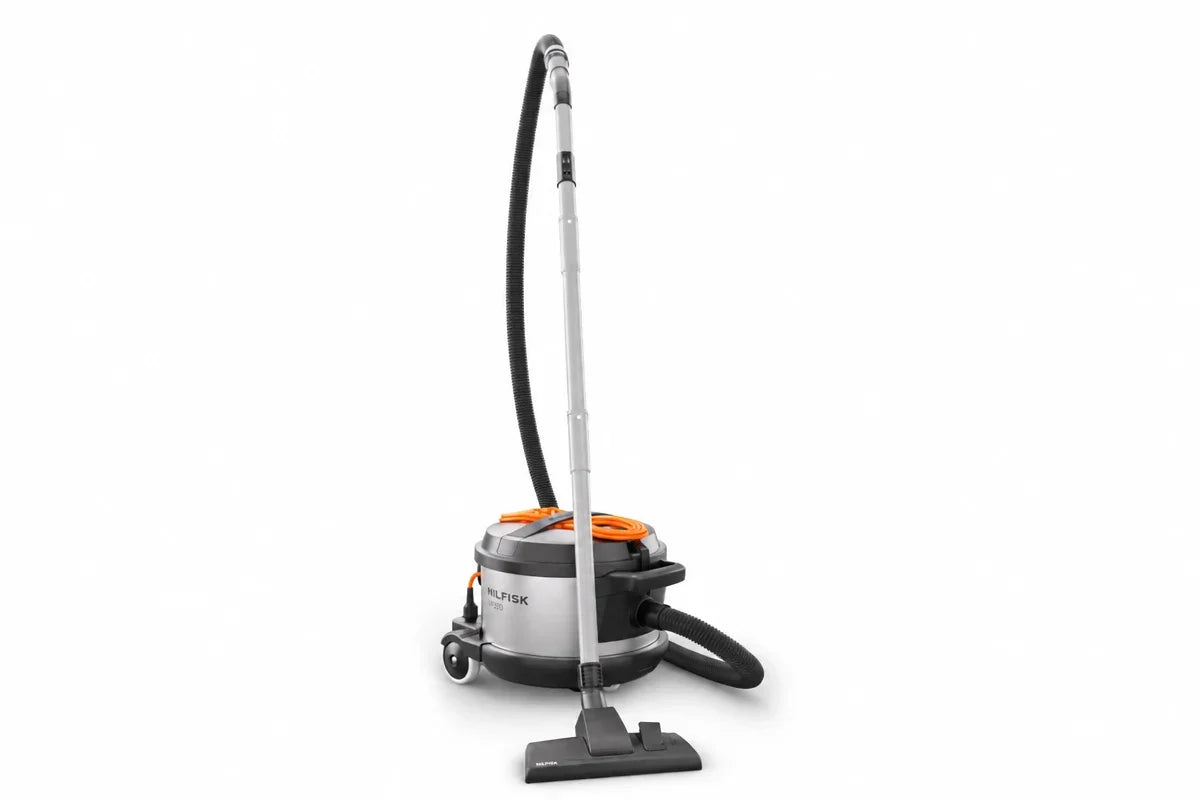
The best commercial HEPA vacuum for most jobs is the Abatement Technologies V930D, a canister with a certified HEPA filter that catches 99.97% of particles at 0.3 microns. If your crew dusts long rows of shelves, they can wear the Sandia HEPA Hipster on the hip, and on stairs, the Sandia 6-quart HEPA Raven is light enough at 9.5 lb to carry on their back.
What Makes a Commercial Grade HEPA Vacuum
Plenty of vacuums say "HEPA" on the box, and plenty of crews have still seen a gray haze puff out of the exhaust. For lead paint work, the EPA's Renovation, Repair and Painting rule sets three conditions for a HEPA vacuum:
- Last stage: The HEPA filter has to be the last filter the air passes through.
- Rating: It has to catch 99.97% of particles at 0.3 microns (far too small to see).
- No leaks: All the air the vacuum pulls in has to go through that filter, with none leaking around it.
If the filter isn't sealed tight in its housing, dust slips around the edges, and your crew is back to watching that gray haze. We ranked the V930D first because its HEPA filter has been certified at that 99.97% rating.
Best Commercial HEPA Vacuums Compared
All three have HEPA filtration. Your crew will notice the differences in how they carry each machine and how loud it gets around people. Every 10 dB sounds about twice as loud to the people nearby, and that makes the Hipster about three times as loud as the V930D. Prices are as of November 2026, so check each listing for the latest price.
| Model | Format | Weight | Noise | HEPA | Cord | Price |
|---|---|---|---|---|---|---|
| Abatement Technologies V930D | Canister | 16.5 lb | 53 dB | Certified HEPA filter, 99.97% at 0.3 µm | 32 ft | $821 |
| Sandia HEPA Hipster 30-3001 | Hip | 12 lb | 69 to 70 dB | HEPA filtration | 50 ft | $738 |
| Sandia HEPA Raven 70-4001 | Backpack | 9.5 lb | 67 dB | HEPA bag and HEPA motor filter | 50 ft | $720 |
Best Commercial HEPA Vacuum Overall: Abatement Technologies V930D
If your crew is cleaning up after a renovation in a school that's still in session, start with the V930D. At 53 dB, it's quiet enough that the teacher next door won't come knocking. Renovation dust settles on every ledge, and with the dust brush and crevice nozzle, your crew can work it off the blinds and out of the bookshelf corners without it drifting back down behind them.
Best Commercial HEPA Hip Vacuum: Sandia HEPA Hipster

If your crew does the nightly dusting in a library, they can wear the Hipster on the hip while they work the wand along the shelves. With the 50-foot (15 m) cord, they can reach the end of a row of stacks before anyone hunts for another outlet. The cap reverses, too, so your one left-handed crew member can switch the hose to their side instead of reaching across their body all night.
Best Commercial HEPA Backpack Vacuum for Stairs: Sandia 6-Quart HEPA Raven

If your crew carries a canister up four flights of carpeted stairs, they have one hand on the railing and none left for the wand. With the 6-quart HEPA Raven on their back, both hands are free, and with the HEPA bag and HEPA motor filter, they can pull the fine dust out of the corners of every step and keep it in the bag. On long routes, the 10-quart version from our commercial backpack vacuum picks holds 10 quarts instead of 6.
Best Commercial HEPA Vacuum for Mold
On a mold job, your crew will save the HEPA vacuum for the final cleanup. Under the EPA's mold remediation guidance, the moldy drywall and carpet have to come out first, and the area has to dry out before your crew HEPA vacuums what's left, including dust that has drifted past the work area. When they change the filter, they should wear protective gear, and the old filter and everything in the vacuum go into well-sealed plastic bags.
Your crew can use a wet vacuum earlier, but only while the materials are still wet, because once there isn't enough water to hold the spores down, the vacuum blows them around the room. Afterward, they need to rinse and dry the tank, hose and tools, or the mold will be growing inside the vacuum by next week.
Using a Commercial HEPA Vacuum Alongside Other Machines
Most crews keep the HEPA vacuum for the rooms where fine dust is the problem. On a big stretch of open carpet, your crew will finish faster with a commercial upright vacuum, and on a plant floor full of metal chips, they need an industrial vacuum cleaner with a steel tank. And if your crew cleans offices while people are at their desks, they won't find many commercial vacuums for office cleaning quieter than the V930D at 53 dB.

No vacuum, HEPA or otherwise, gets dried finger paint off a kindergarten floor. For that, your crew can loosen the paint with steam from one of our commercial-grade steam cleaners, and scrub the lunchroom next door with a commercial floor scrubber. When somebody has stomped a juice box into the reading-corner carpet, your crew can lift the juice out with a commercial-grade carpet cleaner. If you want to compare more HEPA vacuums, browse our commercial-grade vacuums or call us at (888) 828-8460.
Frequently asked questions
What should you check if dust escapes while you vacuum?
Turn the vacuum off and check that the HEPA filter is fully seated, the gasket around it isn't cracked or flattened, and the right bag is in. Do not use it on a lead or mold job until the leak is fixed.
How can you tell when a HEPA filter needs changing?
If suction drops even with a fresh bag in, the filter is clogging. Change it on the manual's schedule, and on a mold job, bag the old filter as soon as it comes out.