
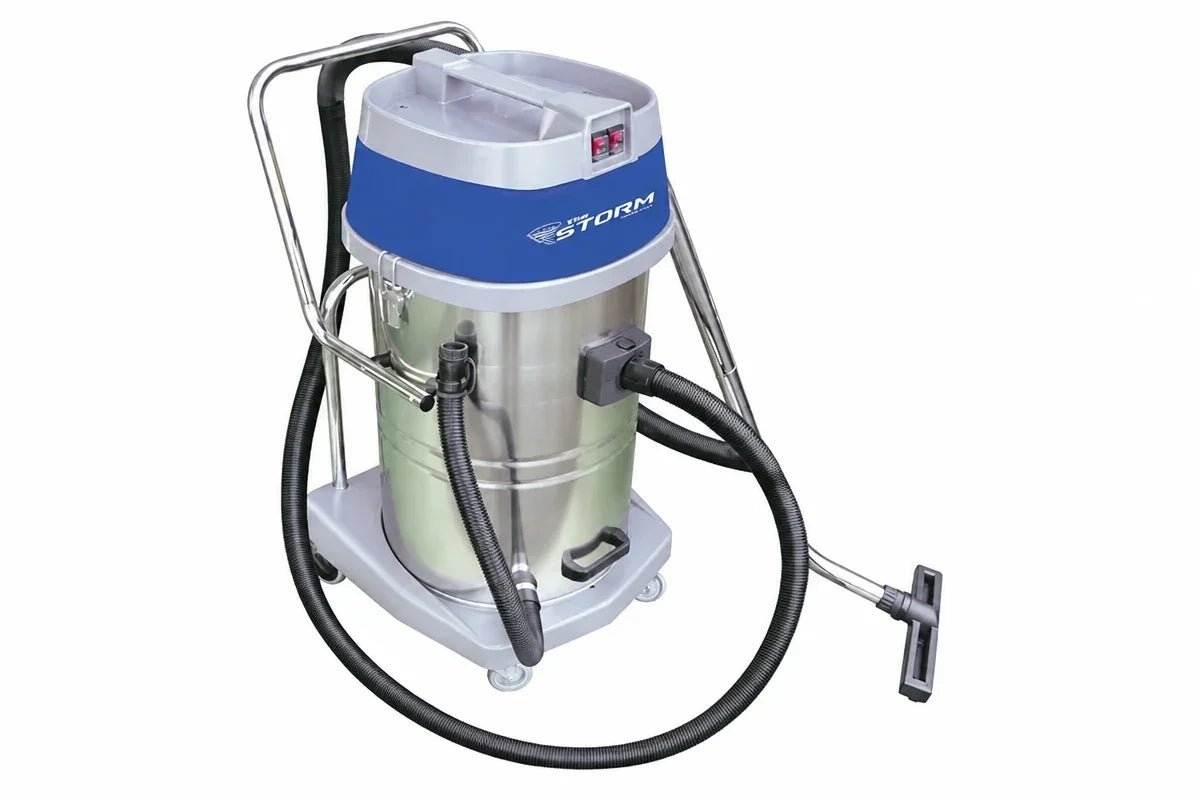
For plant floors and warehouse cleanup, the best industrial vacuum cleaner is the Mercury Storm WVC-20, a wet/dry vacuum with a 20-gallon (76 L) chromed stainless steel tank and two motors.
Where your crew is collecting dust fine enough to need HEPA filtration, use the Abatement Technologies V8000WD. In areas with combustible dust, like aluminum or wood dust, check the area's hazard class first, because your vacuum has to be approved for it.
Choosing a Vacuum Cleaner for Industrial Use
At the end of a shift, a machine shop floor has fine grinding dust, sharp metal chips, coolant puddled under the machines and, in some shops, dust that could potentially ignite. A vacuum set up with a bag for fine dust can clog quickly on chips, and a dry-only unit isn't made to pick up coolant at all. Both of our picks are wet/dry machines, and when a coolant tank overflows or a water line breaks, your crew can step up to a heavy-duty wet/dry vacuum.

Top Industrial Vacuum Cleaners Compared
With more CFM (cubic feet of air per minute), your crew can pick up more dust and chips in each pass across a plant floor. Water lift, measured in inches, is how strong the suction is. The higher it is, the more easily your crew can pull coolant out from under a machine. Prices are as of November 2026, so check each listing for the latest price.
| Model | Style | Price (Nov 2026) | Capacity | Suction | Filtration | When to use it |
|---|---|---|---|---|---|---|
| Mercury Storm WVC-20 | Wet/dry tank | $952 | 20 gal dry, 15 gal wet | 225 CFM, 78 in. water lift | Washable cloth filter | Plant floors and warehouses |
| Abatement Technologies V8000WD | Wet/dry HEPA canister | $861.44 | 8 gal | 135 CFM, 92 in. water lift | Certified HEPA | Fine dust |
Best Industrial Vacuum for Plant Floors: Mercury Storm WVC-20
No matter how many times someone has told them not to, your crew is going to drag the vacuum around by its hose. When a hose pops off halfway through a tug, the dust in it falls straight back onto the floor. On the WVC-20, the hose locks into the tank port, so the whole machine follows when they pull. With the 50-foot (15 m) cord, they can clean a long stretch of aisle before moving to the next outlet.
Coolant on smooth concrete spreads faster than anyone can chase it with a mop. Your crew can pull it up with the squeegee tool from the WVC-20's 5-piece kit, or add Mercury's optional squeegee assembly, which they lower with a step-down foot pedal. At the end of the shift, they can pull out the cloth filter and wash it, and if they let it dry before the next dry pickup, the dust won't cake onto it like wet plaster.
Best Industrial HEPA Vacuum for Fine Dust: Abatement Technologies V8000WD
Grinding and sanding throw up dust fine enough to hang in the air long after the work has stopped. The V8000WD's HEPA filter is certified to capture 99.97% of particles at 0.3 microns, and once your crew has vacuumed that dust up, it stays in the tank. Over a long cleanup, though, all that trapped dust builds up on the filter, and your crew will notice the suction dropping. When that happens, they can clear the filter with Abatement's Push & Clean feature and keep going.

Under the EPA's Renovation, Repair and Painting rule, a commercial HEPA vacuum used on lead paint dust from renovation work has to send all the air it pulls in through the HEPA filter, with none leaking around it. At 59 dB, the V8000WD is quiet enough for a hospital wing under renovation, where the patients on the other side of the plastic sheeting are trying to sleep.
Industrial Vacuum Airflow for Shrouded Tools
When your crew connects a vacuum to a shrouded grinder, the vacuum has to pull enough air through the shroud to catch the dust as fast as the grinding wheel throws it out. NIOSH tested shrouded grinders on tuckpointing (grinding old mortar out from between bricks so masons can replace it), one of the dustiest jobs on a building site. For that work, NIOSH recommends at least 65 CFM at the shroud, with 80 CFM as the target for effective dust control. As debris fills the vacuum, the airflow drops, and once it falls too far, your crew will see dust escaping around the shroud. That's the moment to stop and empty the tank or clean the filter.
Industrial Vacuums for Combustible Dust
A vacuum stirs dust into a cloud inside the tank, and if that dust is combustible, a spark from the motor could set it off. In a 2003 letter on cleaning up aluminum and wood dust, OSHA explained that aluminum dust conducts electricity, and that puts any area where it's present in Class II, Division 1, which is OSHA's higher-risk category for combustible dust. In those areas, every piece of electrical equipment, including the vacuum, has to be approved for the location. Wood dust can put an area in Class II or Class III, depending on the conditions, and it's up to you as the employer to decide which.
Do not use a vacuum in those areas unless its label shows it's approved for that class and group. If you can't find the approval on a listing, call us at (888) 828-8460 before you order.
Reading Industrial Vacuum Cleaner Reviews
When you read industrial vacuum cleaner reviews, look for a reviewer whose work sounds like yours, since a crew that loves a vacuum on office carpet hasn't tested it on metal chips. Skip reviews of household vacuums altogether, because commercial and residential vacuums are made for different work.
On the plant floor, match the dust your crew collects most to one of our commercial vacuums. For all-shift work, Hawk designed the Titan V55, our top heavy duty vacuum cleaner, for continuous use. Baked-on residue on food-processing equipment comes off with heat, and for that, your crew needs one of our commercial steam cleaners, or for the carpeted offices, a commercial carpet steam cleaner.

Frequently asked questions
Can an industrial vacuum pick up flammable liquids?
Do not vacuum solvents, fuel or other flammable liquids with a standard wet/dry vacuum, because a motor spark can ignite their vapor. The V8000WD's listing limits it to non-flammable liquids.
Is a HEPA vacuum safe for combustible dust?
Not on its own. HEPA filtration catches fine particles, and approval for a Class II location covers the motor and electrical parts, so check the listing for both.