
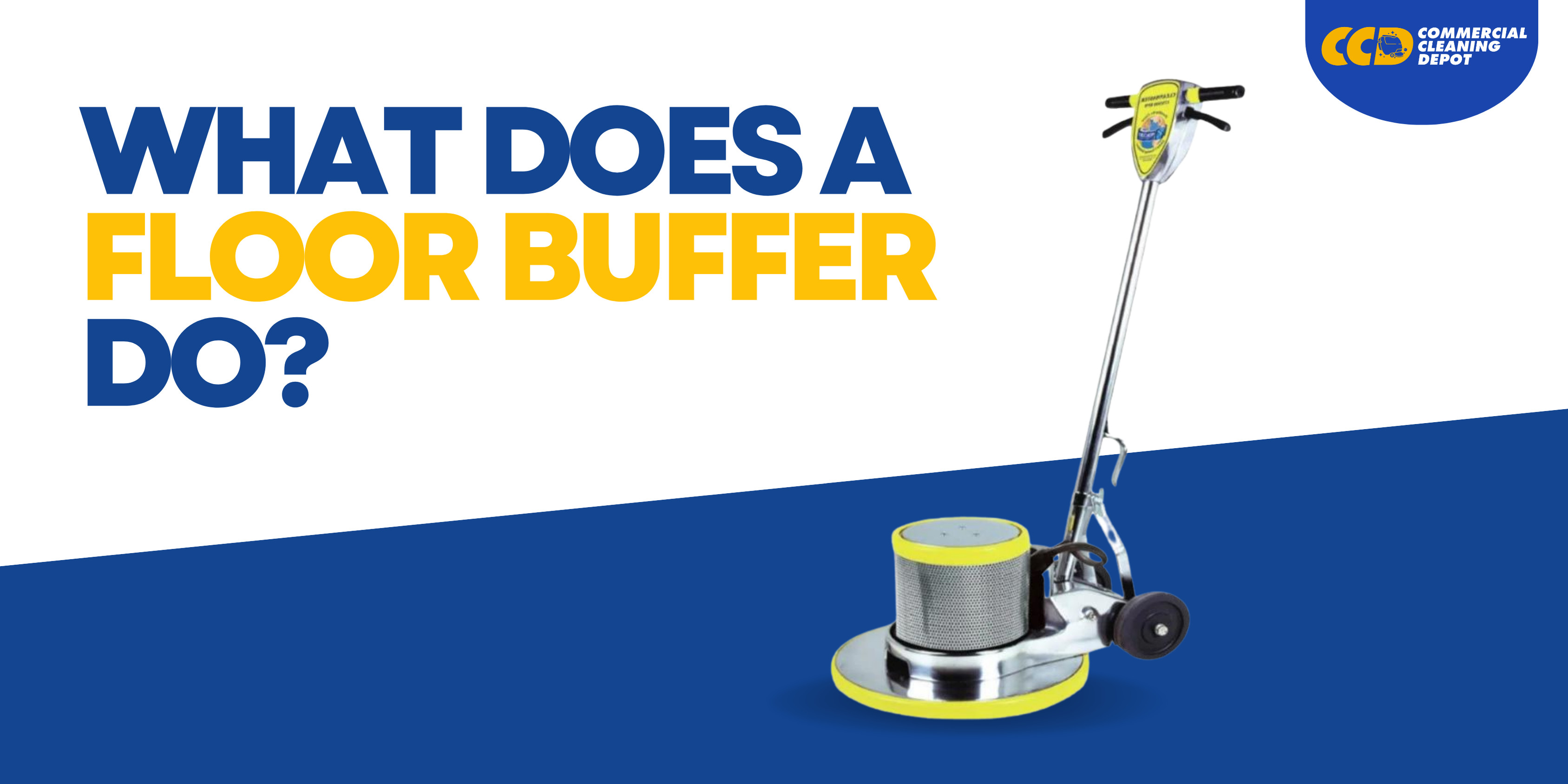
Understanding the Role of Floor Buffers in Commercial Cleaning
Hard floors take a beating in commercial environments. Lobbies, hallways, dining rooms, and hospital corridors absorb hundreds of foot traffic events every day. Without the right maintenance equipment, even premium flooring loses its finish fast, and a dull, scuffed floor sends the wrong message to guests, patients, and inspectors.
Floor buffers solve that problem by scrubbing and polishing hard surfaces like concrete, tile, and hardwood. They also strip old finish and scrub embedded soil or grime. High-speed floor burnishers can bring up a high-gloss shine on surfaces like vinyl and concrete when using the right pad type and chemical. A single machine can handle multiple tasks in one shift.
What Can Floor Buffers Do?

Floor buffers and burnishers are built for a wide range of professional and industrial floor care tasks, including:
- Scrubbing and deep cleaning VCT (vinyl composition tile) floors in schools and retail stores
- Spray buffing to restore gloss between full strip-and-recoat cycles in hotels and office buildings
- Burnishing high-traffic corridors in healthcare facilities for a consistent, professional appearance
- Scrubbing concrete floors in food processing and warehouse environments
- Preparing hardwood floors in restaurants and event venues for new coat application
The Mechanics Behind the Shine
For facility managers and cleaning contractors, a floor buffer determines how a space looks, how long the floor finish lasts, and how much labor your team spends maintaining it. Understanding the mechanics helps you get better results and avoid damaging your floors. Floor buffers and burnishers strip, clean, and polish surfaces using rotating pads or brushes driven by an electric motor. The result depends almost entirely on which pad you choose and what product you apply.
Rotation and Pad Selection
The motor drives a pad driver, the circular plate that holds the cleaning or polishing pad, at speeds that vary by machine type. Low-speed floor buffers typically run at 165 to 175 RPM and are used for scrubbing, stripping, and prepping floors for the application of finish. High-speed floor burnishers run at 1,000 to 3,000 RPM and generate heat through friction, producing the deep, reflective shine that hotels and hospitals want in their lobbies.
Pad color signals its purpose:
|
Pad Color |
Purpose |
|
Black/Brown |
Stripping old wax and finish |
|
Red/Green |
Scrubbing and light cleaning |
|
White/Tan |
Polishing and spray buffing |
|
Natural Fiber |
Final burnishing passes on high-gloss floors |
Matching the pad to the task protects your floor finish and extends its life.
How Buffing Creates a Reflective Surface
Floor surfaces are not perfectly flat at the microscopic level. Foot traffic, grit, and general wear create an uneven texture that scatters light rather than reflecting it cleanly. Floor buffing equipment can level uneven surfaces out, delivering a smooth plane that reflects light evenly.
When spray buffing, abrasive agents in the cleaning or polishing compound remove microscopic high points while the pad distributes finish uniformly across the low points. When dry buffing, the surface's existing finish is "shaved" or "melted" to fill existing voids. In both cases, the result is a floor that looks cleaner and reflects light consistently from wall to wall.
Surfaces Floor Buffers Handle
In commercial settings, the most common surfaces include:
- VCT in schools and healthcare facilities
- Hardwood floors in restaurants and retail spaces
- Terrazzo and marble in hotel lobbies and office buildings
- Concrete in warehouses and food processing facilities
Each surface type has its own finish compatibility requirements. Always check the floor finish manufacturer's guidelines before selecting your pad type and RPM range.
Choosing the Right Floor Buffer for Your Facility

Picking the wrong floor buffer is an expensive mistake. A machine too light for your traffic volume means running it twice as often. Too heavy and you risk damaging delicate finishes. The right match comes down to three factors: your facility size, your floor type, and how often you're cleaning.
Match Machine Speed to Your Floor Type
Speed matters more than most buyers expect. Low-speed machines at 165 to 175 RPM are the right call for stripping, scrubbing, and spray buffing on VCT, terrazzo, and finished concrete. High-speed burnishers at 1,000 to 3,000 RPM are built for harder surfaces like polished concrete and stone where you need a deep, reflective finish.
Matching RPM to floor hardness is what makes that reflection consistent across the whole surface rather than patchy. Running a high-speed burnisher on a soft VCT floor with insufficient finish or lingering too long in one spot can melt the finish and create permanent damage.
If your facility includes multiple surfaces or requires both deep cleaning and high-speed polishing but budget or storage space is limited, a dual-speed floor machine is an excellent solution. These models allow you to adjust between 165 to 175 RPM for heavy-duty scrubbing and stripping and 300 to 350 RPM for faster buffing and gloss restoration. While they won't reach the reflective, 'mirror-like' results of a dedicated 3,000 RPM burnisher, they offer a versatile middle ground for maintaining a clean, professional look.
|
Low-Speed Buffer |
Dual-Speed Machine |
High-Speed Burnisher |
|
|
Speed |
165 to 175 RPM |
165 to 350 RPM |
1,000 to 3,000 RPM |
|
Use |
Stripping, scrubbing, spray buffing, finish prepping |
Multiple-surface facilities needing both deep cleaning and gloss maintenance |
High-gloss restoration on VCT, polished concrete, and natural stone |
|
Surfaces |
VCT, terrazzo, finished concrete, and hardwood |
VCT, hardwood, terrazzo, and concrete |
Polished concrete, natural stone, and VCT |
|
Where? |
Offices, schools, retail stores, and healthcare facilities |
Hospitality and multi-surface buildings |
Hospitals, hotels, and airports |
|
Result |
Clean, maintained appearance |
Professional look without mirror finish |
Deep, reflective shine |
|
Limitations |
Unable to create high-gloss burnished finish |
Won't match a dedicated burnisher for mirror-like results |
Risk of finish damage on soft or under-finished VCT |
|
Suggested Operator Skill |
Low |
Low - medium |
Medium - high |
Size Your Machine to the Facility
Consider the following before settling on a model.
-
Square footage: Large open areas like hotel lobbies and school gymnasiums benefit from wider 20-inch pad drivers; tighter spaces like restrooms and corridors need 17-inch or smaller footprints
-
Traffic frequency: High-traffic facilities such as hospitals, airports, and retail stores may need daily burnishing, which favors a dedicated high-speed unit over a multi-purpose low-speed floor machine
-
Floor transitions: Facilities with multiple floor types may need two machines or a dual-speed model that handles both tasks
-
Operator experience: Heavier, faster machines require more training; lighter units are easier to deploy across a rotating cleaning crew
Cleaning Frequency and Total Cost of Ownership
How often you clean affects which spec tier makes sense. A machine running five days a week in a hospital corridor needs a professional-grade motor rated for continuous use. A machine used twice a week in a small office can tolerate a lighter-duty build without performance problems.
Evaluate duty cycle alongside purchase price. A lower upfront cost can become a higher total cost if the motor burns out under daily commercial load. Look for models with serviceable pad drivers, accessible motor carbon brush rolls, and solid manufacturer warranty support.
Benefits of Using Floor Buffers in Commercial Settings
Floor buffers do more than polish a surface. In commercial environments, they affect how a space is perceived and how long your floor investment lasts.
Aesthetic Benefits
A scuffed, dull floor is not the first impression you want to make on guests, patients, or customers. Regular buffing restores the surface gloss that foot traffic strips away, and in hotels, office lobbies, and retail stores, floor appearance is part of the brand experience.
Key benefits include:
- Removes embedded dirt and surface stains that mopping leaves behind
- Restores gloss and clarity to VCT, hardwood, and terrazzo
- Eliminates scuff marks and heel marks from high-traffic corridors
- Creates a uniform surface finish across large open floor areas
Hygienic Benefits
Appearance and cleanliness are related but not identical. A floor can look shiny and still harbor contaminants in surface scratches and worn finish layers.
Buffing and burnishing compact the floor surface and seal finish layers, reducing the micro-abrasions where bacteria and soil accumulate. This is a measurable advantage in healthcare facilities, food service environments, and school buildings where hygiene standards are enforced.
Key benefits include:
- Smooths surface irregularities that trap dirt and organic matter
- Prepares floors for fresh finish application, which creates a protective barrier
- Reduces daily mopping effort by keeping floors in better base condition
- Extends the interval between full strip-and-recoat cycles, lowering long-term maintenance costs
Operational Benefits
Consistent floor buffing also protects the floor itself. Replacing commercial flooring is a significant capital expense. Routine maintenance with the right buffer extends floor life and defers that cost, which matters for facility managers working under tight maintenance budgets.
Maintaining Your Floor Buffer for Optimal Performance
A floor buffer that isn't maintained will cost you more in the long run. Pads wear unevenly, motors run hot, and drive blocks crack under stress. Keeping your machine in good working order is what separates a buffer that lasts five years from one that lasts fifteen.
Most maintenance tasks take less than ten minutes and require no special tools.
Daily Maintenance After Every Use
Hotels, hospitals, and school facilities run buffers daily. That frequency makes post-shift cleanup non-negotiable.
After each use:
- Remove the pad driver and rinse it thoroughly to prevent finish buildup
- Inspect the pad for tears, uneven wear, or embedded grit that can scratch floors
- Wipe down the base plate and lower housing with a damp cloth
- Check the power cord for kinks, fraying, or damage near the plug
- Coil the cord loosely and hang it off the ground to prevent stress cracks
Never store a buffer with a wet pad attached. Moisture trapped between the pad and driver block causes mold, corrosion of the gripping teeth, and premature foam breakdown.
Weekly and Monthly Checks
Deeper maintenance catches problems before they become failures.
Weekly:
- Inspect the drive block for cracks or wobble, since a loose block causes vibration and uneven pad contact
- Lubricate handle pivot points if your machine has adjustable handle positions
- Test the trigger or on/off switch for smooth, consistent operation
Monthly:
- Check brush or pad driver screws for tightness
- Inspect motor vents for dust and debris, since blocked vents cause overheating in high-use environments like food processing facilities and gyms
- Review your pad inventory and replace any pads showing thinning or uneven compression
FAQ
What is the difference between buffing and burnishing?
Buffing uses low-speed rotation with a chemical or spray to clean and restore gloss. Burnishing uses high-speed friction and heat to produce a deeper, reflective shine. Both maintain floor appearance but serve different stages of the maintenance cycle.
How often should I buff my floors?
It depends on traffic volume. High-traffic facilities like hospitals and hotels may need daily burnishing. Retail and office environments typically require buffing weekly or fortnightly. Strip-and-recoat cycles are usually needed once or twice per year. Remember to scrub high-traffic surface areas before burnishing to avoid embedding any dirt into the finish.
Do I need chemicals to buff floors?
Not always. Dry buffing requires no chemical application. Spray buffing uses a polish or restorer applied during the pass. Scrubbing requires a cleaning solution. The method and your floor's condition determine whether a chemical is needed.
Can one machine handle both stripping and burnishing?
A low-speed buffer can strip and scrub but cannot burnish to a high gloss. A dual-speed machine covers both tasks at a moderate level. For true mirror-finish burnishing alongside stripping, a dedicated high-speed burnisher and a low-speed buffer are the better combination.
How long do floor buffer pads last?
Pad lifespan depends on use frequency and floor condition. In high-use facilities, pads may need replacing weekly. Inspect after every shift for thinning, uneven compression, or embedded grit. A worn pad delivers inconsistent results and risks scratching the floor surface. Most commercial-grade pads are double-sided: flipping the pad halfway through a shift can significantly extend its lifespan.