
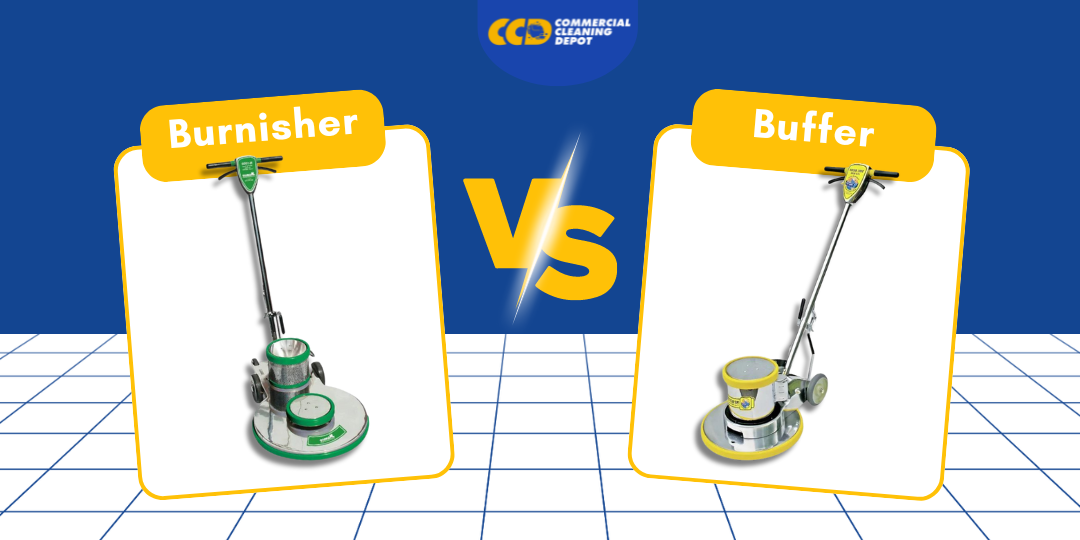
Floor burnishers and buffers are key tools in floor maintenance. They may look similar, but they serve different purposes. Each machine has its own strengths and uses.
Floor buffers operate at slower speeds, typically 175-300 RPM, and are best for cleaning and scrubbing floors. They work in a side-to-side motion, which helps remove dirt and grime. Buffers are good for stripping floors and applying new finishes.
Burnishers run at much higher speeds, often 1000-3000 RPM. They move in a straight line and create a high-gloss shine on floors. Burnishers are ideal for polishing floors after cleaning. They bring out the shine in hard floor surfaces quickly and easily.
Key Takeaways
- Buffers clean and scrub floors at lower speeds, while burnishers polish at high speeds
- The choice between a buffer and a burnisher depends on the specific floor care task
- Both machines play important roles in maintaining clean, attractive floors
Understanding Floor Care Equipment
Floor care equipment is essential for maintaining clean and shiny floors. Buffers and burnishers are two main types of machines used for this purpose.
Distinct Characteristics of Buffers and Burnishers
Buffers are larger machines that spin at lower speeds, typically 175-300 RPM. They're used for cleaning and polishing floors. Buffers require more physical effort to operate due to their size and weight.
Burnishers spin much faster, often 1,500-2,500 RPM. They create a high-gloss "wet look" finish on hard floors. Burnishers are usually easier to maneuver than buffers.
Both machines play important roles in floor maintenance, but serve different purposes. Buffers are better for general cleaning and moderate polishing. Burnishers excel at creating an ultra-shiny finish.
Read more: How to use a floor buffer.
Types of Floor Care Machines
Floor care machines come in several varieties to suit different needs.
Walk behind buffers
Walk-behind buffers are common in many settings. They're versatile for cleaning and polishing a variety of floor types:
- Stand-on burnishers allow operators to ride the machine. This increases productivity in large areas.
- Propane burnishers offer high power and aren't limited by cord length. They're the standard choice in large retail stores, warehouses, and airport terminals where cord management is impractical and continuous operation over 50,000+ sq ft is required.
- Electric burnishers are quieter and produce zero emissions. They work well in smaller areas or places that need frequent touch-ups - and they're the preferred choice for healthcare facilities, schools, and food-service environments where indoor air quality is a priority.
- Ultra-high-speed (UHS) burnishers operate at 2,000-3,000 RPM and are specifically designed for use with UHS floor finish formulations. Using a UHS burnisher on a standard finish can burn or streak the coating, so always match the machine to the finish type.
A floor maintainer (175-300 RPM) is a close relative of the walk-behind buffer. It's designed for dual-purpose cleaning and polishing in a single pass, whereas a dedicated buffer focuses on one task at a time. Choosing the right machine depends on factors like floor type, space size, and desired finish level.
Purpose and Functionality
Floor buffers and burnishers each have a distinct job to do. Buffers handle the cleaning and prep work. Burnishers deliver the final high-gloss result.

What's the Difference Between Buffing and Burnishing?
Buffers focus on cleaning and light polishing and work well for regular upkeep. Burnishers, on the flip side, create a high-gloss shine and are best for final polishing steps.
Also, buffers spin at lower speeds, usually 175-300 RPM. This gentle action cleans dirt and applies wax evenly. Burnishers, on the other hand, operate much faster, often above 1,000 RPM. At this high RPM, the pad generates frictional heat that temporarily softens the polymer chains in the floor finish. As the finish cools within seconds, it rehardens into a smoother, more reflective surface, creating the "wet look" effect.
Both machines can be used on many hard floors, including vinyl composite tile (VCT), marble, and concrete. The right choice depends on the floor type and desired result.
Read more: What does a floor buffer do?
Operational Techniques
Buffers are used in a side-to-side motion, which helps spread cleaning solutions and wax evenly across the floor. Operators guide the machine in overlapping paths to ensure consistent coverage.
One common buffer-specific method is spray buffing, which is lightly misting a diluted floor finish restorer onto the surface while buffing to restore gloss between full strip-and-wax cycles.
Burnishers, in contrast, are operated in a straight forward-and-back motion. Their pads spin at very high speeds to generate frictional heat that briefly softens the floor's polymer finish. As it cools, the finish re-hardens into a smooth, high-gloss surface.
Pad selection is also important. Burnisher pads are usually made from natural or synthetic fibers, such as hog hair or nylon blends, and are rated for specific RPM ranges. Using a pad rated below the machine's speed can lead to pad failure and potential floor damage.
Buffer pads, on the other hand, vary in texture. Rougher pads are used to strip old wax, while softer pads are designed for applying and polishing new wax.
Note: Operating either machine takes practice. Also, there's a need to maintain proper speed, and pressure is key. This is because too much pressure can damage the floor, while too little may result in an uneven or dull finish.
Design and Specifications
Floor buffers and burnishers have distinct physical features and performance capabilities. Their designs impact how they function and the results they achieve.
Physical Attributes
Floor buffers are bigger and heavier than burnishers. This makes buffers harder to move around. They need more space to work and store.

EDIC 17DS3-BK-SV Saturn 17 Inch Dual Speed Floor Buffer Machine
Burnishers, on the other hand, are more compact and easier to handle. Some models come in cordless versions for better mobility. See how it looks:

Hawk 20' centerfold high speed burnisher
Buffer pads range from 13-20 inches in diameter, while burnisher pads are commonly 20-27 inches - that larger footprint means faster coverage on open floors.
The height of these machines can be adjusted on many models. This lets users work comfortably and reach under objects.
Motor and Speed Settings
Motors are key to how these machines work. Buffers run at lower speeds, usually 175-350 RPM. This gentle action is good for cleaning and light polishing.
Burnishers have much faster motors. They can reach 1,000-3,000 RPM. These high speeds create more friction and heat, which leads to the "wet look" finish.
Many machines offer different speed settings. You can pick the right speed for each task. Some high-end models even come with electronic speed control for precise adjustments.
Performance and Efficiency
Floor buffers and burnishers differ in performance and efficiency. The right choice depends on the specific floor type and desired results.

Efficiency on Different Floor Types
Floor buffers work well on many surfaces - vinyl composite tile (VCT), tile, and wood floors. Their lower speeds (175-300 RPM) make them a reliable choice for regular cleaning and waxing without risking surface damage.
Burnishers, on the other hand, shine on hard floors such as concrete or marble. They spin much faster at 1,500-2,500 RPM to generate the heat and friction needed for a mirror-like "wet look" finish.
Verdict: Burnishers are only effective on floors coated with a compatible wax or finish. Bare concrete or unfinished wood will not develop a gloss regardless of machine speed.
Read more: How to use a floor buffer on concrete
Performance Considerations
Buffers are more versatile for general cleaning tasks. They can strip old wax, apply new wax, and do basic polishing. The lower speed means less risk of damage to delicate floors.
Burnishers, however, focus on creating a mirror-like shine. They work best on floors that are already clean and waxed. The high-speed rotation removes tiny scratches for maximum gloss. Many burnishers have dust control systems to improve air quality during use.
Verdict: For daily cleaning, buffers are often more efficient. For high-traffic areas that need extra shine, burnishers deliver better results. The choice comes down to the specific cleaning needs and desired appearance of the floor.
Operation and Handling
Floor buffers and burnishers require different techniques to use effectively. The machines have distinct handling characteristics that affect how easily operators can maneuver them.
Ease of Use
Floor buffers are more challenging to operate than burnishers. They move in a side-to-side motion, which takes practice to control. The only thing you have to learn is how to balance the buffer's weight and movement.
Burnishers, on the other hand, are easier to use. They move forward and backward in straight lines. This simpler motion makes them more user-friendly, especially for beginners.
Verdict: Both machines have handlebars for steering. On burnishers, it's important not to lock the handlebar. This allows for better control and even pad pressure.
Handling and Maneuverability
Floor buffers are larger and heavier than burnishers. Their size makes them harder to maneuver in tight spaces. Operators need strength to guide buffers around obstacles.
Burnishers are more compact and lightweight. This design improves their maneuverability. Operators can easily steer burnishers around furniture and into corners.
The weight distribution also differs between the machines. Buffers concentrate weight on a smaller area, while burnishers spread weight evenly across the pad. This even pressure helps burnishers glide smoothly over floors.
Verdict: Buffers offer power and versatility for deep cleaning and maintenance but require more effort to handle.
Burnishers are easier to maneuver and excel at delivering a high-gloss finish. This makes them perfect for final polishing and larger open areas.
Accessories and Maintenance
Floor buffers and burnishers need proper accessories and upkeep to work well. The right tools and care keep these machines running smoothly for years.

Available Accessories
Pads are key accessories for both buffers and burnishers. There are different pads for various tasks:
- White pads - light cleaning
- Red pads - spray buffing with buffers
- Blue pads - scrubbing with buffers
- Black pads - stripping with buffers
- Green pads - aggressive scrubbing with buffers; removes embedded dirt without a full strip
- Brown pads - dry stripping with buffers; used dry to remove old finish before re-coating
- Tan/natural fiber pads - used exclusively with burnishers for high-speed polishing on waxed floors
Pad color standards are largely consistent across major manufacturers such as 3M, Americo, and Malish, though you should always verify that the pad's RPM rating matches your machine before use.
Pad drivers
Pad drivers attach the pads to the machine. Some units have built-in vacuum systems to collect dust.
Scrubber attachments
Scrubber attachments turn buffers into floor scrubbers. These are good for deep cleaning tile and grout.
Routine Maintenance
Here are some maintenance tips for buffers and burnishers:
- Clean the machine after each use. Wipe down the body and remove any debris.
- Check the power cord for damage. If there are frayed or worn-out cords, replace them right away.
- Before starting any job, inspect the pads and replace any that are worn or excessively dirty. Reusable pads should be cleaned after each use to maintain performance.
- Lubricate moving parts as needed, following the manufacturer's guidelines in the user manual. This helps reduce wear and ensures smooth operation over time.
- For propane burnishers, inspect the LP hose and regulator every 90 days for cracks or wear, as faulty regulators are a leading cause of fires. For electric models, ensure all electrical connections are secure and in good condition.
- Store machines in a clean, dry place when not in use. This prevents rust and damage.
Safety and Precautions
Using floor buffers and burnishers safely requires attention to proper controls, safety features, and best practices. Following key safety steps helps prevent accidents and damage when operating these machines.
Safety Features
Floor buffers and burnishers have built-in safety features to protect users. Most models include:
- Dead-man switches that stop the machine if the handle is released
- Sturdy handles with non-slip grips for better control
- Cord guards to prevent electrical hazards
- Wheel locks to keep the machine stable when not in use
- Protective covers over moving parts
Some burnishers also have dust control systems to reduce airborne particles. Newer models may include safety sensors that shut off the machine if it tips too far.
Best Practices for Safe Operation
Proper training is key for safe use of buffers and burnishers. Users should:
- Read the manual and learn the controls before use
- Wear closed-toe shoes and avoid loose clothing
- Clear the area of obstacles and people
- Check cords and pads for damage before starting
- Keep both hands on the handle during use
- Move at a steady pace and avoid sudden movements
- Unplug the machine when changing pads or performing maintenance
When operating a propane burnisher indoors, ensure the space has adequate ventilation. OSHA (Occupational Safety and Health Administration) recommends a minimum air exchange rate to prevent CO (carbon monoxide) accumulation in enclosed areas.
It's also smart to use caution signs to warn others in the area. Regular checks of safety features help spot issues before they cause problems.
Choosing the Right Machine for Your Needs
Picking the best floor maintenance tool depends on your specific goals and floor types. Consider key factors such as speed, floor material, and desired finish to make the right choice between a buffer and a burnisher.
|
Feature |
Floor Burnisher |
Floor Buffer |
|
Definition |
A machine used to polish and restore the shine of hard floors |
A machine used to clean and polish floors, often with a rotary motion |
|
Primary Function |
Polishing and restoring shine |
Cleaning and polishing |
|
Abrasive Pads |
Uses high-speed burnishing pads |
Uses abrasive pads to remove dirt and grime |
|
Cleaning Ability |
Limited cleaning ability |
Can effectively remove dirt and grime |
|
Finish |
Produces a high-gloss finish |
Produces a more matte or semi-gloss finish |
|
Common Uses |
Maintaining high-gloss finishes on hard floors |
General cleaning and polishing of floors |
|
Efficiency |
Highly efficient for maintaining shine |
Less efficient for deep cleaning compared to scrubbers |
Factors to consider before choosing between a floor buffer and a burnisher
Before choosing either a buffer or burnisher, here are the important factors you must consider:
1. Consider the floor type:
Floor type is crucial when selecting a machine. Buffers work well on most hard floors, including vinyl composite tile (VCT), tile, and wood. Burnishers shine best on harder surfaces like marble or concrete.
2. Your cleaning needs:
Think about your cleaning needs. Buffers are great for regular cleaning and light polishing. Burnishers create a high-gloss finish but aren't for deep cleaning.
3. Speed of the machine:
Speed matters too. Buffers run at 175-300 RPM, while burnishers operate at 1,000-3,000 RPM. Faster speeds mean quicker results but require more skill to use safely.
4. Cleaning space
Space is another factor. Burnishers tend to be larger and work best in open areas - a 20-inch burnisher can cover 10,000-15,000 sq ft per hour, compared to roughly 5,000-8,000 sq ft per hour for a buffer performing the same polishing task.
For healthcare facilities, schools, and food-service environments, use electric burnishers instead of propane models to minimize indoor emissions.
Comparing Cost and Value
A basic walk-behind buffer costs $500-$1,500. Commercial-grade models from brands like Tennant, Nilfisk, or Clarke run $1,500-$3,000. Entry-level electric burnishers start around $800-$1,200, while propane burnishers and high-speed stand-on models range from $2,000-$6,000+.
A 20-inch burnisher covers 10,000-15,000 sq ft per hour - roughly twice the output of a buffer doing the same polishing task.
The bottom line: if your primary need is cleaning and stripping, start with a buffer. If you're maintaining a high-gloss finish on a large commercial floor already coated with wax, a burnisher will deliver faster, better results.
Conclusion
A floor buffer and a floor burnisher solve different problems at different stages of floor care.
Buffers do the heavy lifting: scrubbing, stripping, and prepping floors for a new finish. Burnishers take it from there to transform a clean, waxed floor into a polished surface that looks professional and withstands traffic.
Not sure which machine fits your space? We carry a full range of floor buffers and burnishers suited for facilities of every size. Browse our floor machine collection or reach out to our team. We're happy to help you find the right fit.